[This article also appears on Huffingtonpost.com. You can access it from my author page here.]
The minute the clock strikes midnight Monday night, signifying that November 14 has turned into November 15, the effort to recall Gov. Scott Walker of Wisconsin will begin.
The organizers of the Walker recall have some wind at their backs. They were able to recall two GOP state senators in August. And last Tuesday voters in Ohio overwhelmingly overturned a union-busting law (similar to the one that has made Walker a recall target) that was championed by the state's newly elected Republican governor, while voters in Maine restored same-day voter registration, which had been eliminated by the state's rookie GOP/Tea Party governor and the Republican-controlled legislature.
But recalling Walker will require accumulating more than 500,000 signatures in 60 days just to trigger a recall election. Then the Democratic opponent will have to face an incumbent who will be able to raise tens of millions of dollars from his corporate sponsors. (A Walker supporter formed a bogus recall committee earlier this month as a strategy, allowing the governor to get a head start on fundraising.)
There is one obstacle to a Walker recall that I understand fully, but that I hope won't stop people who oppose the governor's policies from signing a recall petition and voting against him: The idea that using the recall process because you don't like a governor's policies is wrong.
I get it. I admit that, ideologically speaking, I see a lot of merit to the idea that recalls should be reserved for moral, criminal or ethical misconduct. I know regular recall campaigns can create a state of perpetual elections that prevents government from getting anything accomplished. And I find the argument persuasive that the democratic process has to be respected.
I've often said that the democratic process works, even if you don't like the results. When Americans re-elected George W. Bush in 2004, anyone surprised at the incompetence that followed for the next four years clearly wasn't paying attention to his first term. And the same can be said about the 2010 elections. While Walker, like the other Koch Brothers-supported GOP gubernatorial candidates, campaigned on job creation, anyone paying attention had to know that a full-on wish-list of traditional conservative initiatives (union-busting, anti-abortion rules, concealed carry, tax breaks for the wealthy, cuts for education, corporation-friendly laws that hurt consumers, etc.) would ensue, not job creation (something not happening in significant numbers in Wisconsin).
And yet, I will be looking for a petition to sign on November 15. And, if given the chance, I will vote for a Democrat over Walker in a recall election.
Why? My inspiration comes from, of all places, the Tea Party-controlled Republican party. I've watched over the last year as an allegiance to blind ideology has pushed Republicans--in both state and federal settings--into corner after corner, making it impossible to govern responsibly. Want to bargain for long-term deficit reduction? There can't be any compromising because of Tea Party- and Grover Norquist-driven no-tax pledges. Think it might be a mistake to allow visitors to a state capitol building to carry guns? Well, you can't vote against it if you are a rigid ideologue wedded to a vision of Second Amendment supremacy. The list goes on.
The modern GOP, which puts a blind loyalty to far-right-wing ideology over practical governing, has provided me with a wonderful lesson, one I will put into action with Walker's recall.
Yes, in theory, recalls may not be ideal for the democratic process. But unlike the Tea Party-controlled GOP, I will not let ideology get in the way of helping people in need. And there is no doubt in mind that the vast majority of the people of Wisconsin are being hurt by Walker's agenda as governor. He is championing policies that, brick by brick, are rolling back the victories for the middle, working and lower classes won over the last eight decades, trying to turn the clock back to the Hoover years, all in service to his far-right ideology (and, of course, his wealthy and corporate donors).
In addition to the politically motivated union-busting "budget repair" law (he used a budget deficit as a cover to take aim at a key financial supporter of Democratic candidates, so his corporate money could go unchallenged, as well as to pay back his corporate donors like the Koch Brothers, for whom union-busting lies near the center of their agenda), Walker's education cuts are reason alone to support a recall, as they have left the finances of most school districts in trouble (and prevented local communities from taking action to raise money for education).
Walker has pumped out propaganda claiming his policies have helped school districts better handle their finances, but the evidence doesn't back up his claims. Susan Troller of The Cap Times conducted a survey of school district superintendents, and her findings are downright depressing: Bigger classes, discontinued programs, and 3,400 lost jobs (so much for Walker creating jobs). (Troller's piece is a must-read.)
Throw in the governor's concealed carry law, his own voter ID law meant to keep traditional Democratic voters like students and the poor from the polls, and the rest of his anti-middle class, traditional far-right laundry list of initiatives, and it's clear that Walker's policies are a constant attack on the quality of life of a majority of Wisconsin's citizens.
So my concerns about recall efforts must be set aside. It's more important to support the effort to recall Walker, for the good of the state. And I hope others who share my recall concerns come to the same conclusion.
Sunday, November 13, 2011
Tuesday, October 25, 2011
Income Inequality Is the Achilles Heel in the GOP Strategy to Demonize Occupy Wall Street
[This article also appears on Huffingtonpost.com. You can access it from my author page here.]
"I don't care about that."
That is what Rick Perry said in the New York Times when John Harwood told him his tax plan would increase income inequality. Give Perry credit for his honesty. After all, he just articulated out loud what is the accepted dogma of the modern Tea Party-owned Republican party, which is completely dedicated to protecting the wealthy and corporations on the backs of the (rapidly shrinking) middle class, by way of a religious adherence to far-right free market principles.
But there is a danger to Republicans adopting a "Let them eat cake" approach. By dismissing income equality as a key issue, the GOP is headed for a trip wire the party doesn't seem to see coming.
We see it in their approach to Occupy Wall Street. The GOP strategy seems to be that if they can dismiss the protesters as a bunch of crazies (or "human debris," as the always vile Rush Limbaugh put it), then Americans won't notice the issues underlying the protest.
In the short term, the Republican strategy will probably work. By highlighting the elements that look and sound the most out of the mainstream, average Americans won't be able to relate to the protesters and will be wary of being grouped with them.
But what the Republicans are missing is that the anger underneath the Occupy Wall Street protests isn't limited to the dedicated individuals sleeping in a Lower Manhattan park.
So long as the GOP can frame Occupy Wall Street as an attack on the rich or an attack on capitalism, its appeal will be limited. No matter how tough things are with the U.S. economy, Americans don't hate rich people. On the contrary, they aspire to be rich people.
But the middle class can't become wealthy if the government is, through action and inaction, helping the rich get richer while keeping the middle class down, as it has done for the last 30 years (something Jacob Hacker and Paul Pierson demonstrate in "Winner-Take-All Politics").
And Americans have no use for unfairness. They want there to be a correlation between hard work and success. For the financial executives who caused the 2008 financial crisis, there wasn't even a correlation between success and success. Wall Street bankers made billions of dollars for recklessly devising and selling financial instruments they knew were junk, resulting in a near financial collapse that required a government bailout from the Bush administration.
The resulting recession and economic stagnation hit the middle class hard while leaving the wealthiest Americans untouched and corporations flush with cash. (Paul Krugman provided a great recap earlier this month of the abuses that led to the financial crisis.)
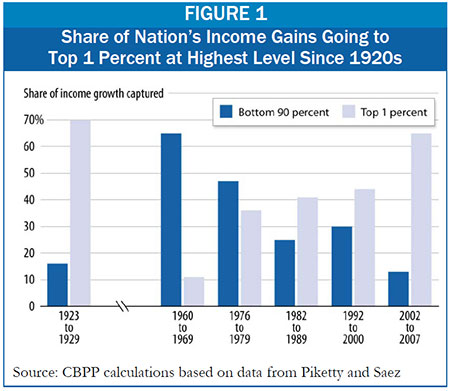
The bottom line is that income inequality has been skyrocketing since Ronald Reagan took office (and accelerated under George W. Bush) behind policies (like massive unpaid-for tax cuts for the wealthy) that had the effect of redistributing income from the middle class upward.
Mother Jones recently compiled some staggering statistics on income inequality:
- Between 2007 and 2009 (pre- and post-financial crisis), Wall Street profits rose 720 percent while American's home equity plummeted 35 percent, all while the unemployment rate went up 102 percent.
- The average income of the top 1 percent has nearly quadrupled since 1980, but the top 20 percent showed only modest growth while the bottom 80 percent flatlined during that period. As a result, the top 1 percent's share of income has exploded by nearly 120 percent since 1980, while the top 20 percent went up a bit and the bottom 80 percent lost its share of income. Put another way, if income growth was equal during the period, the top one percent would have made $597,241 less per household (totaling $673 billion), while the bottom 90 percent would have made more (between $3,733 and $10,100 per household, depending on where the family fell in the percentile list).
- Even as the top 1 percent made out like bandits over the last 30 years, they actually bore less of the tax burden. Between 1992 and 2007, the 400 taxpayers with the highest incomes experienced a 392 percent increase in income but saw their average tax rate go down 37 percent.
- As of 2007, the top 1 percent of Americans in wealth controlled 34.6 percent of America's net worth. The top 10 percent controlled a whopping 73 percent of the country's wealth. And these figures came before the housing bubble burst, hitting the middle and working classes especially hard.
The AP recently did a study that found that the recovery from the 2008 recession has been the most unequal of any recovery since the 1930s. The money did not find its way to the middle class. The percentage of the economy made up of workers' pay and benefits hit an all-time low, all while corporate profits surged, as did CEO compensation. And the stock market recovery put money in the pockets of the wealthiest 10 percent of Americans, even as the middle class continued to struggle and lose ground. In fact, the New York Times ran a front page story today noting how there has been a 53 percent increase in poverty in the suburbs since 2000, with the bulk of that coming after the 2008 financial crisis.
The key to why the Republicans are miscalculating in dismissing income inequality lies in a telling piece of data Mother Jones provides: The actual distribution of income in the United States is far more unbalanced than Americans think it is, and, as importantly, far, far above what they think it should be.
The Republicans want to claim that the Democrats are engaging in class warfare by trying to let the Bush tax cuts for the wealthy expire, but the Republicans have been waging a class war on behalf of the top ten percent against everyone else for the last 30 years.
It's not about hating on the rich. Nobody begrudges entrepreneurs and hard-working visionaries like Steve Jobs and Warren Buffet their successes. No, the anger underneath Occupy Wall Street is about fairness. And income inequality fostered by government policy is not fair.
As unemployment continues to remain high, the economic situation remains murky, and Americans start to see the redistribution of wealth from the middle class to the wealthy, anger will intensify. And when the anger moves from more easily dismissible protesters in Lower Manhattan to a larger swath of the American citizenry, comments like Perry's "I don't care about that" will not be received well.
The participants in Occupy Wall Street may not look like Middle America, and they may not have a polished plan to rectify the problems they are seeking to publicize, but that doesn't make the anger they are expressing less real. More importantly, that anger is shared by more Americans than would make the GOP comfortable.
So Republicans should ridicule Occupy Wall Street at their own risk. They may be able to belittle the protesters, but they can't hide income inequality from the American people.
"I don't care about that."
That is what Rick Perry said in the New York Times when John Harwood told him his tax plan would increase income inequality. Give Perry credit for his honesty. After all, he just articulated out loud what is the accepted dogma of the modern Tea Party-owned Republican party, which is completely dedicated to protecting the wealthy and corporations on the backs of the (rapidly shrinking) middle class, by way of a religious adherence to far-right free market principles.
But there is a danger to Republicans adopting a "Let them eat cake" approach. By dismissing income equality as a key issue, the GOP is headed for a trip wire the party doesn't seem to see coming.
We see it in their approach to Occupy Wall Street. The GOP strategy seems to be that if they can dismiss the protesters as a bunch of crazies (or "human debris," as the always vile Rush Limbaugh put it), then Americans won't notice the issues underlying the protest.
In the short term, the Republican strategy will probably work. By highlighting the elements that look and sound the most out of the mainstream, average Americans won't be able to relate to the protesters and will be wary of being grouped with them.
But what the Republicans are missing is that the anger underneath the Occupy Wall Street protests isn't limited to the dedicated individuals sleeping in a Lower Manhattan park.
So long as the GOP can frame Occupy Wall Street as an attack on the rich or an attack on capitalism, its appeal will be limited. No matter how tough things are with the U.S. economy, Americans don't hate rich people. On the contrary, they aspire to be rich people.
But the middle class can't become wealthy if the government is, through action and inaction, helping the rich get richer while keeping the middle class down, as it has done for the last 30 years (something Jacob Hacker and Paul Pierson demonstrate in "Winner-Take-All Politics").
And Americans have no use for unfairness. They want there to be a correlation between hard work and success. For the financial executives who caused the 2008 financial crisis, there wasn't even a correlation between success and success. Wall Street bankers made billions of dollars for recklessly devising and selling financial instruments they knew were junk, resulting in a near financial collapse that required a government bailout from the Bush administration.
The resulting recession and economic stagnation hit the middle class hard while leaving the wealthiest Americans untouched and corporations flush with cash. (Paul Krugman provided a great recap earlier this month of the abuses that led to the financial crisis.)
The bottom line is that income inequality has been skyrocketing since Ronald Reagan took office (and accelerated under George W. Bush) behind policies (like massive unpaid-for tax cuts for the wealthy) that had the effect of redistributing income from the middle class upward.
Mother Jones recently compiled some staggering statistics on income inequality:
- Between 2007 and 2009 (pre- and post-financial crisis), Wall Street profits rose 720 percent while American's home equity plummeted 35 percent, all while the unemployment rate went up 102 percent.
- The average income of the top 1 percent has nearly quadrupled since 1980, but the top 20 percent showed only modest growth while the bottom 80 percent flatlined during that period. As a result, the top 1 percent's share of income has exploded by nearly 120 percent since 1980, while the top 20 percent went up a bit and the bottom 80 percent lost its share of income. Put another way, if income growth was equal during the period, the top one percent would have made $597,241 less per household (totaling $673 billion), while the bottom 90 percent would have made more (between $3,733 and $10,100 per household, depending on where the family fell in the percentile list).
- Even as the top 1 percent made out like bandits over the last 30 years, they actually bore less of the tax burden. Between 1992 and 2007, the 400 taxpayers with the highest incomes experienced a 392 percent increase in income but saw their average tax rate go down 37 percent.
- As of 2007, the top 1 percent of Americans in wealth controlled 34.6 percent of America's net worth. The top 10 percent controlled a whopping 73 percent of the country's wealth. And these figures came before the housing bubble burst, hitting the middle and working classes especially hard.
The AP recently did a study that found that the recovery from the 2008 recession has been the most unequal of any recovery since the 1930s. The money did not find its way to the middle class. The percentage of the economy made up of workers' pay and benefits hit an all-time low, all while corporate profits surged, as did CEO compensation. And the stock market recovery put money in the pockets of the wealthiest 10 percent of Americans, even as the middle class continued to struggle and lose ground. In fact, the New York Times ran a front page story today noting how there has been a 53 percent increase in poverty in the suburbs since 2000, with the bulk of that coming after the 2008 financial crisis.
The key to why the Republicans are miscalculating in dismissing income inequality lies in a telling piece of data Mother Jones provides: The actual distribution of income in the United States is far more unbalanced than Americans think it is, and, as importantly, far, far above what they think it should be.
The Republicans want to claim that the Democrats are engaging in class warfare by trying to let the Bush tax cuts for the wealthy expire, but the Republicans have been waging a class war on behalf of the top ten percent against everyone else for the last 30 years.
It's not about hating on the rich. Nobody begrudges entrepreneurs and hard-working visionaries like Steve Jobs and Warren Buffet their successes. No, the anger underneath Occupy Wall Street is about fairness. And income inequality fostered by government policy is not fair.
As unemployment continues to remain high, the economic situation remains murky, and Americans start to see the redistribution of wealth from the middle class to the wealthy, anger will intensify. And when the anger moves from more easily dismissible protesters in Lower Manhattan to a larger swath of the American citizenry, comments like Perry's "I don't care about that" will not be received well.
The participants in Occupy Wall Street may not look like Middle America, and they may not have a polished plan to rectify the problems they are seeking to publicize, but that doesn't make the anger they are expressing less real. More importantly, that anger is shared by more Americans than would make the GOP comfortable.
So Republicans should ridicule Occupy Wall Street at their own risk. They may be able to belittle the protesters, but they can't hide income inequality from the American people.

Wednesday, September 21, 2011
I Hope Obama's Veto Threat Is the Start of a New Effort to Fight Back Against the GOP
[This article also appears on Huffingtonpost.com. You can access it from my author page here.]
When I read that Jerry Brown was "bewildered and stunned" at how ideological and uncompromising the GOP had become in California, I was surprised and dismayed, all at the same time.
I was surprised because I had to wonder if the governor had been paying attention to national politics. I've discussed how the Republicans have become a Tea Party-captured institution of far-right activism. Even conservative columnist David Brooks went from arguing in November 2010 that pragmatic conservatives would dominate the Republican leadership in the House to a full-on anti-Tea Party rant in July 2011, declaring that the GOP had been "infected by a faction that is more of a psychological protest than a practical, governing alternative" and that would not "accept the logic of compromise" or "accept the legitimacy of scholars and intellectual authorities." He went on to conclude that they have "no economic theory worthy of the name" and "no sense of moral decency."
But I was dismayed, because it only made clearer how much damage the Tea Party-captured Republicans are doing to the country's political process, and how few people outside of those immersed in politics seem to be noticing. And, as I discussed after the debt ceiling battle, I've had it with the total capitulation of the Democrats and the president.
What really struck me about the timing of the Brown piece in the New York Times was that over the last few weeks, it feels as though I've seen story after story that exposes the very specific agenda of the new GOP, which is, as 28-year-veteran Republican Congressional staffer Mike Lofgren put it, "solely and exclusively" interested in helping the wealthy (while camouflaging their policy positions to hide their true motives). Specifically, in just the last few weeks:
- After successfully dangling the U.S. economy over a cliff and threatening to drop it in a bid to extort spending cuts before agreeing to raising the debt ceiling, the GOP again is playing chicken, refusing to pass legislation funding the government (which could lead to a government shut-down) if they can't extort spending cuts in exchange for helping people suffering from the effects of natural disasters like Hurricane Irene. And this comes just weeks after the Republicans held the funding of the FAA hostage (resulting in the loss of tens of millions of dollars in uncollected taxes from the airlines) while trying to include cuts and union-busting provisions to the legislation.
- With millions of Americans out of work and more suffering due to the slow economy, the Republican leadership in Congress wrote a letter to Federal Reserve Chairman Ben Bernanke asking him not to try and help spur the economy (something CNBC described as "highly unusual"), blatantly and callously putting their political strategy for 2012 ahead of what's best for the American people.
- The Republicans energetically and vehemently went on the offensive to protect the wealthy from the president's proposed tax on millionaires to help spread the sacrifice in addressing the long-term budget situation, but rejected the president's call for a middle class payroll tax break. (Fortunately, Mother Jones came up with a short, to-the-point, six-item list demonstrating the fictional assertions behind the GOP's stated reasons for opposing a millionaire tax.)
And the Republican refusal to consider any revenue increases to help cut the deficit goes against the views of an overwhelming majority of the American people, including Republicans. A July Gallup poll revealed that while Americans do want cuts to close the budget gap, 68 percent of Republicans and 69 percent of independents said that their preferred method to balance the budget included at least some tax increases.
But I'm also dismayed because I'm afraid Brown's surprise at GOP unreasonableness is symbolic of the lack of understanding of Democrats in how to handle what is happening in the country now. After all, despite holding positions shared by a majority of the American people (on issues from gay marriage to tax increases on the wealthy), the party hasn't made a clear case as to why they should be preferred to Republicans. The president's poll numbers are falling, a Republican won a special election to fill Anthony Weiner's House seat (yes, I know the Democrats ran a weak candidate and Ed Koch decided that the Orthodox Jewish candidate would be worse at protecting Israel than the Catholic one, but a Democrat losing a House seat in Queens and Brooklyn is newsworthy), and the Democrats are in the strategically problematic position of defending far more Senate seats than the Republicans in 2012.
The problem can be summed up in some recent conflicting poll numbers. Greg Sargent wrote in the Washington Post how a recent MSNBC/Wall Street Journal poll found that while a majority disapproved of the president's handling of the economy, those same respondents nevertheless supported his policies over those of the GOP.
Clearly, there is a disconnect between policy and politics.
Part of the problem, of course, is that by failing time and time again to stand up to the Tea Party Republicans in the House, the Democrats haven't provided a clear contrast for voters. And in doing so, they've allowed the conversation to shift to the right, with the GOP agenda dominating the conversation. But I think it's more than that. I think that in the current atmosphere in the country, policy positions aren't enough. It's about emotion.
My thinking on this issue came from the oddest place: A 2009 Fox News program. As part of my research for my graduate school thesis, I have been doing a textual analysis of cable news programs in August 2009, around the time Sarah Palin coined the term "death panels" to misrepresent provisions in proposed health care reform legislation (it was PolitiFacts' top lie of 2009). I was reading the transcript from Sean Hannity's August 13, 2009, show, during which a member of his "focus group" said, in reference to the 2008 election: "I felt very safe with Bush. And that was a prime issue for me."
Knowing what we know now, how, under President Obama, U.S. military, intelligence and law enforcement agencies have stepped up drone attacks in Pakistan, decimated al-Qaida, cut off threats to America before they could take place, and, most of all, killed Osama bin Laden, the woman's statement has no basis in fact.
But she wasn't making a factual assertion. She was expressing a feeling. She bought the line the GOP was pushing in the campaign (and continued to push in 2009) that Obama wouldn't do enough to keep the country safe from terrorists, and that's how she felt.
What does that have to do with 2011? Well, the emotions being felt by many Americans now are equally pronounced. After three years of a down economy since the financial crisis, they're worried and angry. And all they see in government is dysfunction (putting aside for the moment the reason for the dysfunction). For example, in a Wall Street Journal/NBC News poll, 71 percent of respondents had a negative view of the debt ceiling deal, and they blamed both parties for the mess.
So like the woman who felt safer with Bush, voting decisions may not match up with the facts. Democrats have to recognize and work with the anger and fear that Americans are feeling. And they can best do that by demonstrating how they differ from the current crop of extremist, unreasonable Tea Party Republicans.
Which is why the president's threat this week to veto any deficit-reduction bill that doesn't include tax increases on the wealthy along with cuts to Medicare is so important. It's not just the issue (a vast majority agree with him), but for once he seems to be fighting for the American people. For once, it appears like he gets it. Is it too late? There is no way of knowing if voters (especially independents) have irretrievably soured on the president. But something had to change.
There is an anti-incumbent feeling now. Congress's approval rating is, according to a New York Times/CBS News poll, a record low 12 percent. At this point, other than partisans on both sides, too many Americans think there is no difference between the parties. They think both parties are bought and paid for by special interests, and that they're not looking out for the American people. While it's true that too many Democrats are beholden to the corporations that fund their campaigns, there is a real difference between the parties. We saw the damage George W. Bush inflicted on the country for most of the 2000s, and we are seeing the far-right agenda being relentlessly pursued as we speak by the Republicans who control the House. If the GOP were to control Congress and the White House, things would get much worse for most Americans in a hurry.
I understand that President Obama is very interested in appearing above the fray, avoiding partisan battles. But the current GOP is interested in nothing but partisan battles. They are focused on defeating President Obama in 2012, not lowering unemployment or jump-starting the economy. Democrats in Washington, including the president, have to start doing a better job of addressing the fears and anger of the American people, while pointing to the differences in the policies of the two parties. They have to find a way to demonstrate that the Republicans' policies are not only potentially disastrous, but they seek to redistribute wealth upward, helping the rich get richer, destroying the middle class, and further pushing the wealth disparity to levels not seen since Hoover was president. And that means standing up to the Tea Party and forcing the debate back toward the center.
Since in office, the president has been more interested in policy than politics, but policy alone isn't enough anymore. As Jerry Brown discovered, things have changed. Many Americans don't see a difference in the parties. They're afraid, and they're angry. It's up to the Democrats, especially the president, to understand the lay of the land an act accordingly. If they don't, the anger- and fear-driven anti-incumbent fervor could drive the party from Washington, no matter what their policy positions are. And that would be disastrous for the American people.
When I read that Jerry Brown was "bewildered and stunned" at how ideological and uncompromising the GOP had become in California, I was surprised and dismayed, all at the same time.
I was surprised because I had to wonder if the governor had been paying attention to national politics. I've discussed how the Republicans have become a Tea Party-captured institution of far-right activism. Even conservative columnist David Brooks went from arguing in November 2010 that pragmatic conservatives would dominate the Republican leadership in the House to a full-on anti-Tea Party rant in July 2011, declaring that the GOP had been "infected by a faction that is more of a psychological protest than a practical, governing alternative" and that would not "accept the logic of compromise" or "accept the legitimacy of scholars and intellectual authorities." He went on to conclude that they have "no economic theory worthy of the name" and "no sense of moral decency."
But I was dismayed, because it only made clearer how much damage the Tea Party-captured Republicans are doing to the country's political process, and how few people outside of those immersed in politics seem to be noticing. And, as I discussed after the debt ceiling battle, I've had it with the total capitulation of the Democrats and the president.
What really struck me about the timing of the Brown piece in the New York Times was that over the last few weeks, it feels as though I've seen story after story that exposes the very specific agenda of the new GOP, which is, as 28-year-veteran Republican Congressional staffer Mike Lofgren put it, "solely and exclusively" interested in helping the wealthy (while camouflaging their policy positions to hide their true motives). Specifically, in just the last few weeks:
- After successfully dangling the U.S. economy over a cliff and threatening to drop it in a bid to extort spending cuts before agreeing to raising the debt ceiling, the GOP again is playing chicken, refusing to pass legislation funding the government (which could lead to a government shut-down) if they can't extort spending cuts in exchange for helping people suffering from the effects of natural disasters like Hurricane Irene. And this comes just weeks after the Republicans held the funding of the FAA hostage (resulting in the loss of tens of millions of dollars in uncollected taxes from the airlines) while trying to include cuts and union-busting provisions to the legislation.
- With millions of Americans out of work and more suffering due to the slow economy, the Republican leadership in Congress wrote a letter to Federal Reserve Chairman Ben Bernanke asking him not to try and help spur the economy (something CNBC described as "highly unusual"), blatantly and callously putting their political strategy for 2012 ahead of what's best for the American people.
- The Republicans energetically and vehemently went on the offensive to protect the wealthy from the president's proposed tax on millionaires to help spread the sacrifice in addressing the long-term budget situation, but rejected the president's call for a middle class payroll tax break. (Fortunately, Mother Jones came up with a short, to-the-point, six-item list demonstrating the fictional assertions behind the GOP's stated reasons for opposing a millionaire tax.)
And the Republican refusal to consider any revenue increases to help cut the deficit goes against the views of an overwhelming majority of the American people, including Republicans. A July Gallup poll revealed that while Americans do want cuts to close the budget gap, 68 percent of Republicans and 69 percent of independents said that their preferred method to balance the budget included at least some tax increases.
But I'm also dismayed because I'm afraid Brown's surprise at GOP unreasonableness is symbolic of the lack of understanding of Democrats in how to handle what is happening in the country now. After all, despite holding positions shared by a majority of the American people (on issues from gay marriage to tax increases on the wealthy), the party hasn't made a clear case as to why they should be preferred to Republicans. The president's poll numbers are falling, a Republican won a special election to fill Anthony Weiner's House seat (yes, I know the Democrats ran a weak candidate and Ed Koch decided that the Orthodox Jewish candidate would be worse at protecting Israel than the Catholic one, but a Democrat losing a House seat in Queens and Brooklyn is newsworthy), and the Democrats are in the strategically problematic position of defending far more Senate seats than the Republicans in 2012.
The problem can be summed up in some recent conflicting poll numbers. Greg Sargent wrote in the Washington Post how a recent MSNBC/Wall Street Journal poll found that while a majority disapproved of the president's handling of the economy, those same respondents nevertheless supported his policies over those of the GOP.
Clearly, there is a disconnect between policy and politics.
Part of the problem, of course, is that by failing time and time again to stand up to the Tea Party Republicans in the House, the Democrats haven't provided a clear contrast for voters. And in doing so, they've allowed the conversation to shift to the right, with the GOP agenda dominating the conversation. But I think it's more than that. I think that in the current atmosphere in the country, policy positions aren't enough. It's about emotion.
My thinking on this issue came from the oddest place: A 2009 Fox News program. As part of my research for my graduate school thesis, I have been doing a textual analysis of cable news programs in August 2009, around the time Sarah Palin coined the term "death panels" to misrepresent provisions in proposed health care reform legislation (it was PolitiFacts' top lie of 2009). I was reading the transcript from Sean Hannity's August 13, 2009, show, during which a member of his "focus group" said, in reference to the 2008 election: "I felt very safe with Bush. And that was a prime issue for me."
Knowing what we know now, how, under President Obama, U.S. military, intelligence and law enforcement agencies have stepped up drone attacks in Pakistan, decimated al-Qaida, cut off threats to America before they could take place, and, most of all, killed Osama bin Laden, the woman's statement has no basis in fact.
But she wasn't making a factual assertion. She was expressing a feeling. She bought the line the GOP was pushing in the campaign (and continued to push in 2009) that Obama wouldn't do enough to keep the country safe from terrorists, and that's how she felt.
What does that have to do with 2011? Well, the emotions being felt by many Americans now are equally pronounced. After three years of a down economy since the financial crisis, they're worried and angry. And all they see in government is dysfunction (putting aside for the moment the reason for the dysfunction). For example, in a Wall Street Journal/NBC News poll, 71 percent of respondents had a negative view of the debt ceiling deal, and they blamed both parties for the mess.
So like the woman who felt safer with Bush, voting decisions may not match up with the facts. Democrats have to recognize and work with the anger and fear that Americans are feeling. And they can best do that by demonstrating how they differ from the current crop of extremist, unreasonable Tea Party Republicans.
Which is why the president's threat this week to veto any deficit-reduction bill that doesn't include tax increases on the wealthy along with cuts to Medicare is so important. It's not just the issue (a vast majority agree with him), but for once he seems to be fighting for the American people. For once, it appears like he gets it. Is it too late? There is no way of knowing if voters (especially independents) have irretrievably soured on the president. But something had to change.
There is an anti-incumbent feeling now. Congress's approval rating is, according to a New York Times/CBS News poll, a record low 12 percent. At this point, other than partisans on both sides, too many Americans think there is no difference between the parties. They think both parties are bought and paid for by special interests, and that they're not looking out for the American people. While it's true that too many Democrats are beholden to the corporations that fund their campaigns, there is a real difference between the parties. We saw the damage George W. Bush inflicted on the country for most of the 2000s, and we are seeing the far-right agenda being relentlessly pursued as we speak by the Republicans who control the House. If the GOP were to control Congress and the White House, things would get much worse for most Americans in a hurry.
I understand that President Obama is very interested in appearing above the fray, avoiding partisan battles. But the current GOP is interested in nothing but partisan battles. They are focused on defeating President Obama in 2012, not lowering unemployment or jump-starting the economy. Democrats in Washington, including the president, have to start doing a better job of addressing the fears and anger of the American people, while pointing to the differences in the policies of the two parties. They have to find a way to demonstrate that the Republicans' policies are not only potentially disastrous, but they seek to redistribute wealth upward, helping the rich get richer, destroying the middle class, and further pushing the wealth disparity to levels not seen since Hoover was president. And that means standing up to the Tea Party and forcing the debate back toward the center.
Since in office, the president has been more interested in policy than politics, but policy alone isn't enough anymore. As Jerry Brown discovered, things have changed. Many Americans don't see a difference in the parties. They're afraid, and they're angry. It's up to the Democrats, especially the president, to understand the lay of the land an act accordingly. If they don't, the anger- and fear-driven anti-incumbent fervor could drive the party from Washington, no matter what their policy positions are. And that would be disastrous for the American people.
Subscribe to:
Posts (Atom)